Excitability and Dynamical Systems
Voltage clamp, Hodgkin–Huxley and Morris–Lecar models, phase-plane analysis, linear stability, excitability, and square-wave bursting.
Topics to Explore
- Classical biophysics of the squid giant axon; the Hodgkin-Huxley model and equivalent circuit; ODE models with gating variables coupled to current balance equations.
- Voltage-clamp recording; interpretation of voltage-clamp recordings for the major ionic currents, including the L- and T-type Ca2+ currents, Isag, Ca2+-activated potassium currents, persistent sodium currents, etc.; inward vs. outward currents; currents activated via depolarization vs. hyperpolarization; transient vs. persistent currents; tail currents.
- Interpretation of experimental voltage-clamp and current-clamp recordings; the effects of channel blockers and modulators such as TTX and TEA; aspects of neurological channelopathies emphasized in readings; the role of calcium channels in higher-level brain function.
- The Morris-Lecar model of the barnacle muscle fiber; physiological interpretation of dynamics in phase plane; type 1 vs. type 2 excitability, including whether action potentials are graded in amplitude or all-or-none; type 1 vs. type 2 oscillations, including the dependence of amplitude and frequency on applied current when oscillations emerge.
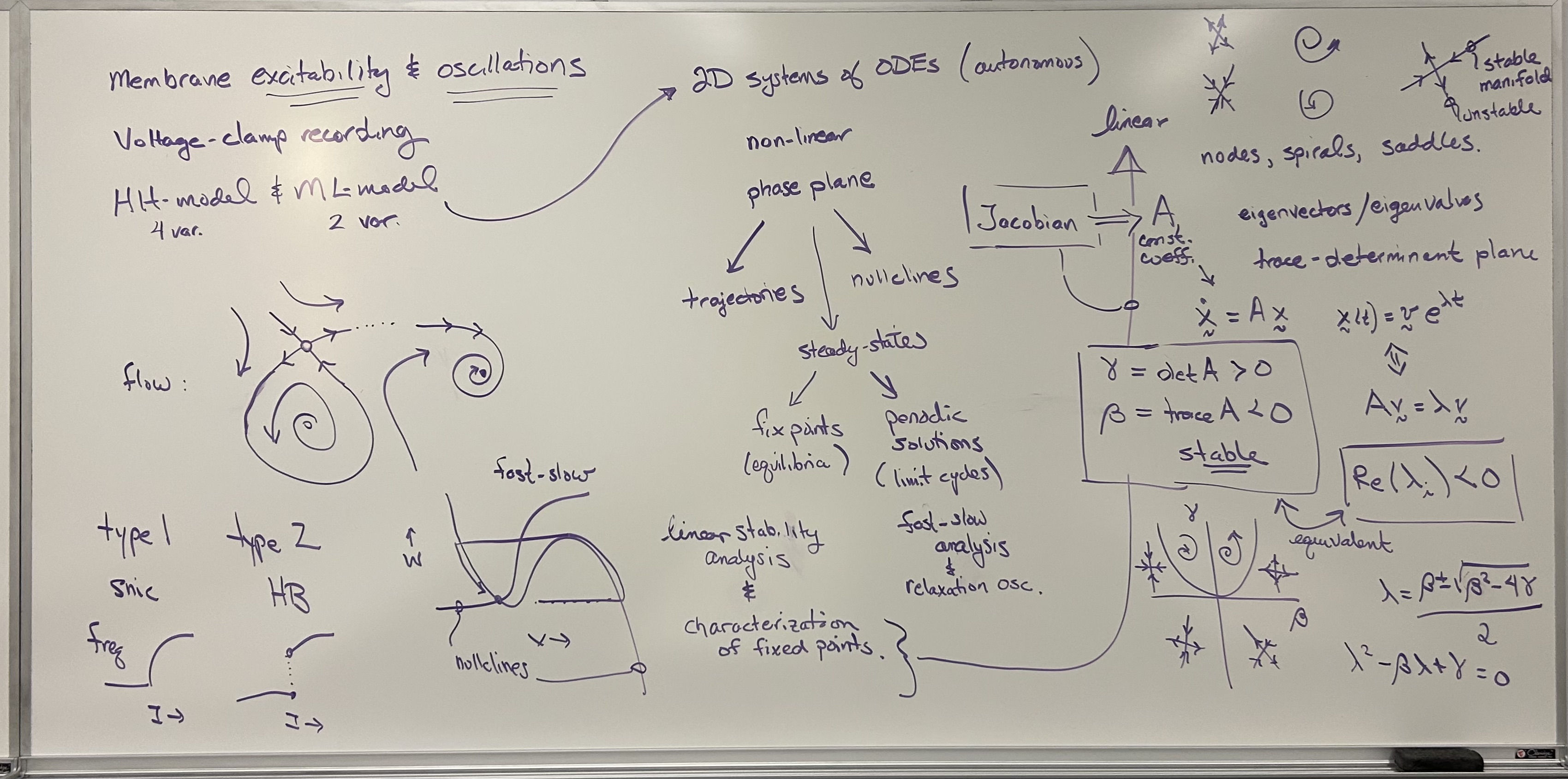
- Phase plane analysis for 2d autonomous ODEs; direction fields; nullclines; horizontal vs. vertical trajectories crossing nullclines; identifying the direction of flow in regions of the phase plane between nullclines.
- Stable and unstable manifolds of a saddle; homoclinic and heteroclinic trajectories; attractors vs. repellors.
- Trajectories in 2d phase plane when one variable is faster than the other; excitability and relaxation oscillations in systems with separated time scales.
- Linear stability analysis and classification of equilibria in 2d systems; straight line solutions when eigenvalues are real and distinct; the trace-determinant plane; relationship between eigenvalues, trace, and determinant; evaluating the Jacobian at an equilibrium point.
- Interpreting bifurcation diagrams summarizing the number or stability of steady states and periodic solutions of an ODE model; saddle-node, subcritical and supercritical Hopf bifurcation, limit cycle fold, saddle-node on an invariant circle, saddle-node loop bifurcation; local vs. global bifurcations.
- Slow passage through different types of bifurcation; square-wave, elliptic, and parabolic bursters; physiological mechanisms of bursting, such as slow dynamics of a membrane current; the low-threshold calcium spike and post-inhibitory rebound bursting.
Lectures
Connections Across Unit 2
This whiteboard connects membrane excitability and oscillations with phase planes, nullclines, linear stability, eigenvalues, and the trace–determinant plane.
View the full-size whiteboard.